Rogers vs. FR4 PCB Materials: Which is Better for Your High-Frequency Applications?
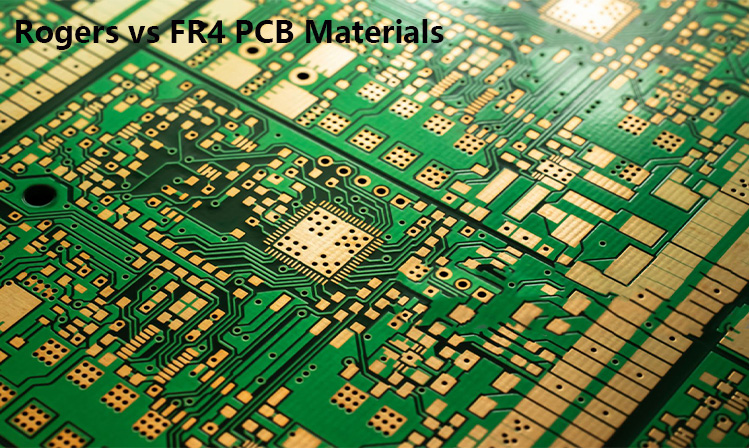
In high-frequency circuit design, the choice of PCB substrate directly determines signal integrity, loss control, and overall system performance. For radio frequency (RF), microwave, millimeter-wave, and high-speed digital circuits, two common materials are Rogers and FR4.
Rogers vs. FR4 PCB Materials: Which is Better for Your High-Frequency Applications?
What is FR4 Material?
IPC defines FR4 as a glass fiber reinforced epoxy resin laminate material. It is currently the most widely used PCB substrate.
Key characteristics of FR4:
Dielectric constant (Dk): Approximately 4.2–4.8 (varies significantly with frequency)
Loss factor (Df): Approximately 0.015–0.025
Low cost
High mechanical strength
Mature processing and stable supply chain

Suitable applications for FR4:Conventional consumer electronics
Industrial control equipment
Power modules
Low-frequency or medium-speed digital circuits
For applications below 1 GHz, FR4 is generally sufficient. However, as the frequency increases, issues with material loss and dielectric constant instability become increasingly apparent.
What are Rogers Materials?
Rogers Corporation is an American company specializing in high-performance engineering materials. Its high-frequency PCB materials are widely used in the radio frequency and microwave fields.
Common series include:RO4003C、RO4350B、RT/duroid series
Key characteristics of Rogers materials:
Low dielectric constant (Dk): approx. 2.2–3.66
Extremely low loss factor (Df): 0.0009–0.0037
Stable Dk at high frequencies
Excellent thermal stability
Better impedance control
Typical applications:
- 5G communication equipment
- Radar systems
- Satellite communications
- RF amplifiers
- Automotive millimeter-wave radar
- High-speed signals (>10GHz)
Rogers vs FR4: Core Performance ComparisonComparison Items: FR4 Rogers
Difference: Dielectric constant stability: Large variation with frequency; Stable at high frequencies
Loss factor: High; Extremely low
High-frequency performance: Average; Excellent
Cost: Low; High
Processing difficulty: Standard process; Requires special control
Mixed-pressing support: Can be mixed with Rogers; Common
When must you choose Rogers?If your design meets the following criteria, Rogers is recommended as a priority:
1️⃣ Operating frequency > 2GHz
FR4 loss increases rapidly at high frequencies, leading to increased signal attenuation and crosstalk.
2️⃣ Sensitive to insertion loss
Such as RF front-end modules, filters, etc.
3️⃣ Strict impedance control requirements
Material consistency is critical in applications such as high-speed SerDes and millimeter-wave antenna arrays.
4️⃣ Requires lower signal delay ripple
Low Dk materials can reduce propagation delay.
When is FR4 still the best choice?Not all high-end projects require Rogers.
If your application:
Frequency < 1GHz
Primarily power supply or control board
Cost sensitive
Large-scale production
Then FR4 remains a highly cost-effective solution.
Hybrid Lamination Boards: A Solution Balancing Performance and CostIn many 5G or RF applications, engineers use a Rogers + FR4 hybrid lamination structure:
Rogers is used for high-frequency signal layers
FR4 is used for other layers
This solution can:Reduce overall cost
Maintain high-frequency performance of critical layers
Meet the needs of complex multilayer designs (e.g., 8-layer, 12-layer or higher high-precision boards)
For PCB factories with high-precision multilayer manufacturing capabilities, lamination control and CTE matching of hybrid lamination boards are particularly critical.
How Significant is the Cost Difference?Generally speaking:Rogers material costs 3–8 times more than FR4
Higher requirements for processing yield and process control
Slightly longer lead times
However, for high-frequency systems, incorrect material selection can lead to substandard overall performance, with hidden costs far exceeding the material price difference.
How to Choose the Right Material for You?Before selecting a PCB, we recommend confirming the following parameters:
- Operating frequency range
- Target impedance
- Maximum allowable insertion loss
- Operating temperature range
- Product lifespan
- Cost budget
If you are unsure whether Rogers is necessary, we recommend providing your Gerber documentation and stackup requirements for a professional evaluation.
Professional Advice: Material Planning from the Design Stage
In high-frequency PCB design, materials not only affect electrical performance but also:
Impedance calculation model
Layer stack-up structure
Copper thickness selection
Surface treatment (ENIG/immersion silver, etc.)
For high-frequency projects, we recommend communicating with the PCB manufacturer early in the design phase to avoid time and cost losses due to later modifications.
Which is more suitable for your high-frequency application?
✔ For RF, microwave, and millimeter-wave applications – Rogers is the preferred choice.
✔ For conventional digital circuits or cost-sensitive projects – FR4 is more economical.
✔ If you want to balance performance and cost – choose a Rogers + FR4 hybrid board.
There are no absolutely superior or inferior materials, only those suitable for your application scenario.
If you are developing 5G, radar, or high-speed communication products and require professional high-frequency PCB manufacturing support, please contact us for technical advice and pricing support. We can provide Rogers, FR4, and mixed-layer multilayer high-precision PCB solutions to help your projects achieve stable mass production.